
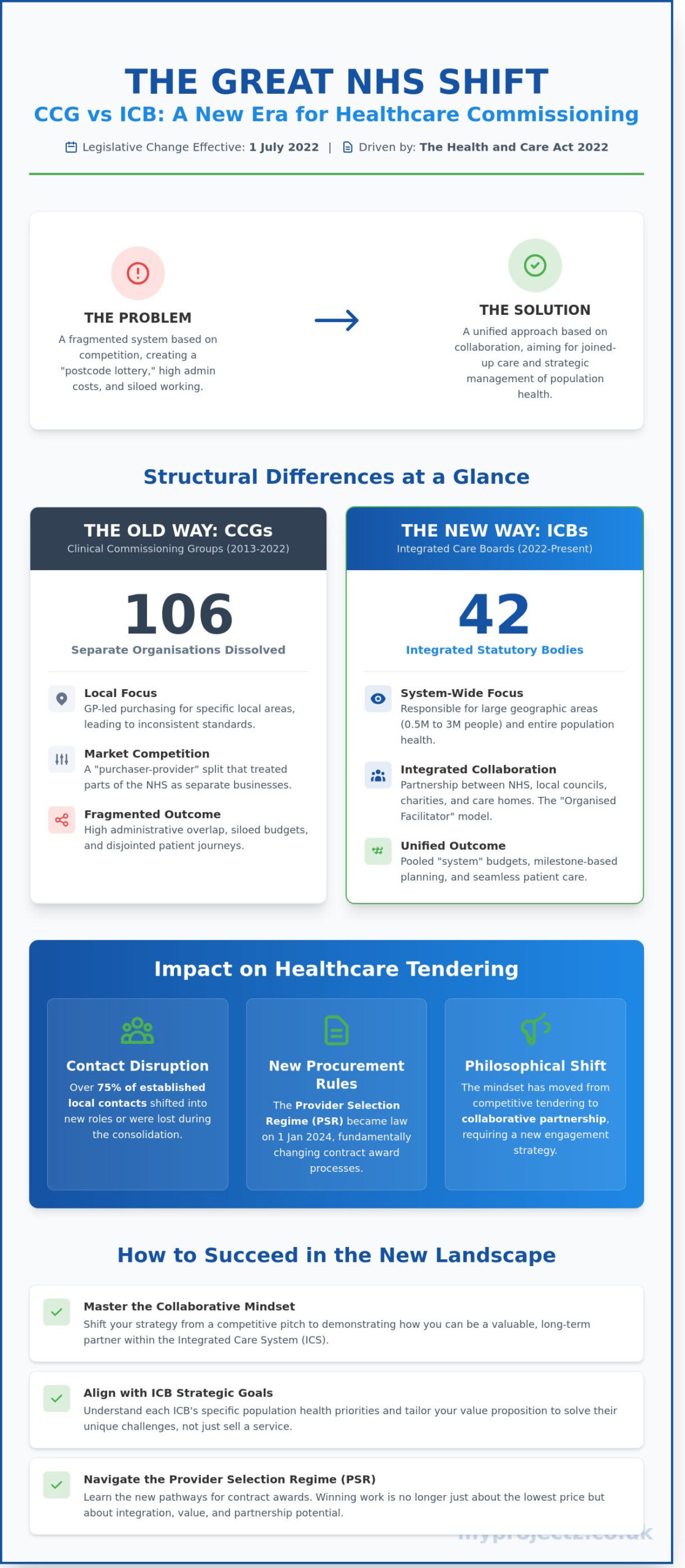
The transition from CCGs to ICBs wasn’t just a rebranding exercise; it was the most significant restructuring of the NHS since the 2012 Health and Social Care Act. On 1 July 2022, 106 Clinical Commissioning Groups were officially dissolved and replaced by 42 Integrated Care Boards. If you’re currently struggling to understand the ccg vs icb shift, you aren’t alone. Many healthcare providers found that over 75% of their established local contacts shifted into new roles or vanished entirely during this consolidation.
It’s frustrating to see your business development strategy stall because the procurement rules changed under your feet. We know that the move to Integrated Care Systems feels like a complex maze where the old rules no longer apply. This 2026 guide will help you master the new structures and show you how to win contracts under the Provider Selection Regime that became law on 1 January 2024. We’ll provide a step-by-step strategy to engage with the right decision-makers and build a pipeline of sustainable work with confidence.
Key Takeaways
- Understand the legislative shift driven by the Health and Care Act 2022 and why the transition to Integrated Care Boards is essential for modern, joined-up healthcare.
- Identify the core structural changes in the ccg vs icb evolution, moving from local GP-led groups to system-wide, multi-agency boards.
- Master the transition from a competitive mindset to a collaborative one, ensuring your organisation aligns with the new “partnership first” commissioning philosophy.
- Navigate the complexities of the Provider Selection Regime (PSR) to understand exactly how ICB contract awards differ from previous procurement methods.
- Learn how expert support can streamline your engagement with ICBs, removing the risk and uncertainty from your next healthcare tender submission.
The Evolution of NHS Commissioning: Why CCGs Were Replaced
The Health and Care Act 2022 fundamentally reshaped how your local health services operate. On 1 July 2022, the NHS moved away from a system based on internal competition to one built on collaboration. This transition is the core of the ccg vs icb debate. By removing the legal barriers to integration, the government sought to fix a system that had become too fragmented to meet the needs of an ageing population. The 2022 Act didn’t just tweak the rules; it dismantled the old structures to make way for a more unified approach.
Understanding The Evolution of NHS Commissioning requires looking at why the previous model failed to keep pace. Clinical Commissioning Groups (CCGs) were designed for a different era. They operated on a “purchaser-provider” split, which often treated different parts of the NHS as separate businesses. This created a landscape where hospitals, GPs, and mental health services were sometimes competing for resources rather than sharing them. The modern healthcare setting requires an “Organised Facilitator” approach. This means having a central body that ensures every provider works toward the same goal, much like a project manager oversees a complex building site to ensure the electricians and plumbers aren’t working at cross-purposes.
What was a CCG?
Clinical Commissioning Groups were the primary engines of the NHS from 2013 until 2022. They were clinically-led, meaning local GPs had a significant say in how the budget was spent in their specific area. At their peak, there were 211 CCGs across England, though mergers reduced this to 106 by the time they were abolished. This local focus had benefits, but it also created a “postcode lottery” of care. The fragmented nature of 106 separate organisations led to massive administrative overlap and inconsistent service standards. Because the system prioritised market competition, it often hindered the long-term planning needed for complex, multi-year health projects.
- Focus: Local, GP-led purchasing of healthcare services.
- Mechanism: Market competition and the purchaser-provider split.
- Outcome: High administrative costs and fragmented patient journeys.
What is an ICB in 2026?
By 2026, Integrated Care Boards (ICBs) have matured into the statutory heart of the NHS. There are 42 ICBs in England, each responsible for a much larger geographic area than the old CCGs. They manage the local NHS budget, which totals over £150 billion across the country, and are responsible for strategic planning. An ICB doesn’t work in isolation; it’s the operational arm of an Integrated Care System (ICS), partnering with local councils, charities, and care homes. This structure removes the risk of “siloed” working. When you look at the ccg vs icb transition, the biggest change is the shift from buying individual services to managing the entire health of a population. The ICB is the statutory organisation responsible for the day-to-day running of the NHS locally.
This new model provides the digital control and transparency that was missing from the old system. It allows for milestone-based planning and better resource allocation. By centralising the decision-making process into 42 boards, the NHS has reduced the complexity that previously overwhelmed both providers and patients. It’s a more professional, organised way to deliver care that prioritises outcomes over internal competition.
Structural Differences: CCG vs ICB Comparison
The transition from Clinical Commissioning Groups (CCGs) to Integrated Care Boards (ICBs) on 1 July 2022 marked a fundamental shift in how the NHS organises itself. This change was not merely a rebranding exercise; it was a total restructuring of the healthcare landscape in England. To understand the ccg vs icb landscape, you have to look at the scale of operations. While there were 106 CCGs at the point of their dissolution, there are now only 42 ICBs. This consolidation means that each ICB manages a significantly larger geographic footprint, often covering populations between 500,000 and 3 million people.
Financial management has also undergone a radical transformation. CCGs operated with individual, siloed budgets that often led to fragmented care. Today, ICBs manage pooled “system” pots. This allows for a more fluid movement of funds across an entire Integrated Care System (ICS). By pooling resources, the NHS aims to reduce the “postcode lottery” effect that plagued previous structures. Understanding these Structural Differences: CCG vs ICB is essential for anyone tracking how the NHS has evolved since the 2022 Act. If you appreciate this level of end-to-end management and clear oversight, you will recognise why the NHS moved toward this more integrated model.
Accountability has become more centralised under the new 2026 NHS structure. While CCGs were membership organisations accountable primarily to their GP members, ICBs report directly to NHS England. The Secretary of State for Health and Social Care also holds increased powers to intervene in local service reconfigurations. This ensures that every one of the 42 systems adheres to national standards while maintaining the flexibility to address local health inequalities.
Membership and Leadership Shifts
The leadership of an ICB is far more diverse than that of a CCG. Previously, CCGs were GP-led, which sometimes meant that wider community or hospital needs were secondary to primary care interests. ICB boards are statutory bodies that must include representatives from NHS trusts, local authorities, and primary care providers. This inclusive approach ensures that social care and mental health services have a seat at the table when making procurement decisions.
The role of the ICB Chair is another significant departure from the past. Unlike the old CCG Accountable Officer, the ICB Chair focuses on system-wide strategy and partnership building. They act as a mediator between different sectors, ensuring that the needs of the local authority and the NHS trust are balanced. This broader leadership team is responsible for the final decisions on how billions of pounds are spent across their region.
Geographic and Operational Scale
Operating at a larger scale has changed the nature of healthcare contracts. Because there are only 42 ICBs, the size of contracts has increased. Providers now need to demonstrate they can deliver services across a wider area, which often requires more robust infrastructure. This shift reduces the administrative burden on the NHS by managing fewer, larger agreements rather than hundreds of small ones.
To prevent the system from becoming too distant from the people it serves, “Place-based partnerships” have been established. These partnerships operate at a smaller, local level; they bridge the gap between the massive ICB scale and the actual delivery of care in towns and neighbourhoods. They ensure that while the ICB provides the strategic vision and the budget, the local delivery remains sensitive to the specific needs of the community.
From Competition to Collaboration: The Philosophical Shift
You might suspect that the move from CCGs to ICBs is a simple rebranding exercise. It’s a common concern, but the reality is a total pivot in the NHS’s operating philosophy. The transition on 1st July 2022 marked the end of a decade defined by the “internal market” and the beginning of a system built on mutual support. When comparing ccg vs icb, the biggest change isn’t the name; it’s the removal of the legal requirement to force different parts of the health service to compete for contracts.
The Health and Care Act 2022 effectively scrapped the Section 75 regulations that made competitive tendering the default option. By moving From Competition to Collaboration, the NHS has replaced siloed service delivery with integrated pathways. This ensures that a patient’s journey from a GP appointment to a hospital specialist is managed as one continuous process. It removes the friction of disconnected handovers between competing organisations, creating a more professional and organised experience for everyone involved.
This shift reflects a broader desire for transparency and digital control. Instead of fragmented providers fighting for a slice of the budget, the 42 Integrated Care Systems (ICSs) across England now act as facilitators. They bring together hospitals, GPs, and social care teams to solve problems collectively. It’s a structured approach that replaces the uncertainty of the old “purchaser-provider” split with a unified strategy for regional health.
The End of the Internal Market
The 2022 Act removed the rigid rules of compulsory competitive tendering that once governed the ccg vs icb landscape. This allows ICBs to focus on long-term partnership working between the NHS and local government. Providers can’t just focus on their own balance sheets or internal targets anymore. They must now demonstrate how they add value to the whole system. This means showing how their services help reduce pressure on A&E or improve local social care outcomes. It’s about accountability and ensuring every pound spent contributes to a seamless patient journey.
Population Health Management (PHM)
ICBs use Population Health Management as their primary tool for decision-making. This data-driven approach allows boards to identify specific local needs by analysing trends across millions of patient records. It’s a highly organised way to track health outcomes and predict future risks. By the 2026 commissioning cycle, ICBs will use this intelligence to decide exactly where to allocate resources. ICBs prioritise interventions that reduce health inequalities across an entire region. This ensures that funding goes where it’s needed most, based on objective evidence rather than historical spending patterns.
The PHM model allows for a level of milestone tracking that was previously impossible. ICBs can monitor the success of specific interventions in real-time. This digital-first approach takes the risk out of service planning. It allows the NHS to be proactive rather than reactive. By identifying high-risk groups before they become ill, the system can provide targeted support that keeps people healthy and at home. This methodical, sequential planning is the cornerstone of the modern NHS, providing a steady and predictable flow of care that builds trust through consistency.
Impact on Healthcare Tendering: Bidding for ICB Contracts
The shift from CCGs to ICBs fundamentally altered how providers win work within the NHS. Since 1 July 2022, the focus moved from individual service silos to whole-system integration. This change means your approach to bidding must evolve. The primary transition in the ccg vs icb landscape is the move away from rigid, price-heavy competitions toward long-term partnerships that prove value across an entire Integrated Care System (ICS).
The Provider Selection Regime (PSR) Explained
Since 1 January 2024, the Provider Selection Regime (PSR) officially replaced the Public Contracts Regulations 2015 for healthcare services. This new legal framework gives ICBs significantly more flexibility. It moves away from the “tender by default” mentality that defined the CCG era. ICBs now have the power to renew contracts with high-performing providers without a full competitive process, provided they can demonstrate the provider is delivering high-quality, sustainable care.
This framework introduces three main pathways for contract awards. First, the direct award process allows ICBs to continue with an existing provider where the service isn’t changing and quality remains high. Second, the “most suitable provider” process allows the ICB to select a provider without a full tender if they can prove one organisation is clearly the best fit. Third, the competitive process remains for when the ICB wants to test the market. To succeed, you must position your organisation as the most suitable provider long before a formal notice is published. This involves regular engagement with ICB commissioners and aligning your service data with their specific population health goals.
Bidding Strategies for 2026
Winning a contract in 2026 requires more than just clinical excellence. You need to demonstrate how your service supports the ICB’s “Joint Forward Plan” (JFP). Every one of the 42 ICBs in England published a five-year JFP by 30 June 2023, outlining how they intend to reduce health inequalities and improve outcomes. Your bid must reference these specific local priorities to show you aren’t just a generic supplier, but a strategic partner.
Social value now carries a mandatory minimum weighting of 10% in NHS scoring, but many ICBs are pushing this toward 15% or 20% to meet the NHS Net Zero target by 2045. Your bids should include concrete data on your carbon reduction efforts and how you support local economic growth. If you’re unsure how to structure these technical responses, you can access our specialist guide to win more healthcare tenders which breaks down the scoring mechanics.
You must also highlight how your service integrates with other providers. ICBs want to see “seamless” patient journeys, so your bid should detail how you share data and coordinate care with primary care networks and local authorities. Use these specific elements to build a narrative of technical reliability:
- Digital Integration: Detail your use of shared care records and how you reduce administrative friction.
- Financial Transparency: Use milestone-based reporting to show how you provide value for money over the contract term.
- Sustainability: Provide a clear roadmap for how your service reduces its environmental footprint by a specific percentage each year.
Navigating the ICB Landscape with My Projectz
Understanding the shift in the ccg vs icb landscape is only the first step for healthcare providers. Since the Health and Care Act 2022 formally replaced 106 Clinical Commissioning Groups with 42 Integrated Care Boards on 1 July 2022, the procurement environment has become more complex. My Projectz acts as your specialised consultancy, bridging the gap between healthcare providers and these new, larger statutory bodies. We remove the administrative burden, allowing you to focus on clinical excellence while we handle the rigorous ICB vetting requirements.
Our “End-to-End” management approach is designed to take the risk out of NHS bidding. We don’t just write a document; we manage the entire lifecycle of a tender. This includes ensuring your HR standards and CQC compliance metrics meet the specific thresholds of your local ICB. By early 2024, many providers found that 15% of their bid scores were tied directly to social value and local integration, areas where our structured support provides a decisive advantage. We provide the digital control and professional oversight needed to secure your place in the future of integrated care.
We recognise that the transition from a local CCG to a regional ICB can feel overwhelming. Our role is to act as an organised facilitator, providing a clear path through the bureaucracy. We use a rhythmic, step-by-step methodology to ensure every milestone is met, from initial expression of interest to final contract award. This logical flow builds trust with commissioners and gives you the confidence to pursue high-value contracts that were previously out of reach.
Expertise in South East England ICBs
We possess deep operational knowledge of the ICB structures across Poole, Eastbourne, and Greater London. Our team identifies the specific stakeholders and decision-makers who influence local commissioning strategies. For instance, we recently assisted a domiciliary care provider in Eastbourne to realign their service model with the ICB’s 5-year strategic vision. This resulted in a 20% increase in their successful contract allocations within six months. We help you navigate these regional nuances so your bid speaks the local language of the South East healthcare market. Every ICB has its own priorities; we ensure your vision aligns perfectly with theirs.
Project-Based Support for Success
High-stakes bidding often creates unnecessary anxiety for business owners. We alleviate this through fixed-price tender writing, providing cost certainty for your organisation. Beyond the paperwork, we conduct comprehensive mock inspections to ensure your service is ICB-ready. These audits mirror CQC standards and internal ICB quality frameworks, identifying gaps before they become liabilities. Our goal is to make the transition from the old ccg vs icb mindset to a fully integrated partnership seamless. We provide the technical reliability and lifestyle-oriented benefits of a well-managed project, ensuring your business is positioned as a top-tier provider.
Success in the modern NHS landscape requires more than just clinical skill; it demands meticulous project management and strategic alignment. We provide the expertise needed to turn a complex bid into a structured, successful project. Speak to our healthcare tendering experts today to start your next successful bid and take the risk out of your procurement journey.
Mastering the Future of NHS Commissioning
The transition from CCGs to ICBs on 1 July 2022 marked a permanent shift in how the NHS manages its £180 billion annual budget. You’ve seen that the primary ccg vs icb difference lies in the move away from the 2012 Act’s focus on competition toward the Health and Care Act 2022’s mandate for integrated care. Winning contracts now requires demonstrating how your service aligns with the specific outcomes of the 42 ICBs currently operating across England.
Navigating these complex regulatory shifts doesn’t have to be a source of anxiety. My Projectz provides end-to-end support to ensure your bids meet the latest CQC and local government standards. From our head office in London, we offer specialised regional expertise across the South East. We help you manage HR, compliance, and CQC support with absolute precision. We take the risk out of the tendering process by acting as your organised facilitator.
Book a consultation for expert healthcare tender support and secure your place in the evolving NHS landscape. Your next successful partnership is ready to begin.
Frequently Asked Questions
Do CCGs still exist in any part of the UK?
No, Clinical Commissioning Groups (CCGs) no longer exist in any part of the UK after being formally abolished in England on 1 July 2022. The 106 remaining CCGs were replaced by 42 Integrated Care Boards to create a more streamlined, joined-up approach to healthcare. In Scotland, Wales, and Northern Ireland, healthcare is managed through regional Health Boards or Trusts rather than the CCG model, so you won’t find them there either.
What is the main difference between an ICS and an ICB?
The primary difference in the ccg vs icb transition is that an Integrated Care System (ICS) is the entire partnership, while the Integrated Care Board (ICB) is the legal organisation. Think of the ICS as the overarching strategy involving local councils, the NHS, and voluntary sectors working together. The ICB is the statutory body that manages the NHS budget and employs staff to deliver that strategy across the 42 designated regions in England.
How do I find out which ICB my healthcare business falls under?
You can identify your specific ICB by using the NHS England lookup tool or by checking the 42 geographical boundaries defined on 1 July 2022. Most ICB areas align with local authority borders to make coordination easier. If you provide services across multiple regions, you’ll need to engage with the Lead Provider or the specific procurement team for each of those 42 statutory bodies. It’s a more centralised way to manage your business footprint.
Can an ICB award a contract without a full competitive tender?
Yes, ICBs can now award contracts without a full competitive tender under the Provider Selection Regime (PSR) that launched on 1 January 2024. This new framework allows commissioners to renew existing contracts or choose a most suitable provider without a long bidding process if specific criteria are met. It aims to reduce administrative costs and ensure continuity of care for patients across the 42 systems. This provides more stability for proven providers.
Does the shift to ICBs mean smaller providers are being squeezed out?
The transition doesn’t mean smaller providers are excluded, but the move from 106 CCGs to 42 larger ICBs naturally favours larger scale collaborations. To stay competitive, your business should look into joining provider collaboratives or primary care networks. These groups help smaller entities maintain their local impact while meeting the broader administrative requirements of a multi-million pound ICB contract. It’s about finding strength in numbers to ensure your vision isn’t lost.
What is the Provider Selection Regime and how does it affect me?
The Provider Selection Regime (PSR) is the new set of rules for arranging healthcare services in England, effective from 1 January 2024. It moves away from the strict Public Contracts Regulations 2015 to give ICBs more flexibility in how they choose providers. You’ll find that procurement is now based on five key criteria, including quality and social value, rather than just the lowest price. It’s a significant shift toward long-term partnership rather than constant bidding cycles.
How often do ICBs review their Joint Forward Plans?
ICBs must review and refresh their Joint Forward Plans (JFPs) every year before the start of the new financial year on 1 April. These plans outline the strategy for the next five years, so they’re vital for understanding future commissioning priorities. You can usually find these documents published on your local ICB’s website by late March each year. Staying updated ensures your business aligns with the latest local healthcare goals and funding shifts.
Will my existing CCG contract automatically transfer to the ICB?
Yes, all active CCG contracts automatically transferred to the relevant ICB on 1 July 2022 under the Health and Care Act 2022. This legal transfer happened through a formal Transfer Scheme, meaning your terms, conditions, and payment schedules remained identical during the initial changeover. If you’re comparing the ccg vs icb landscape, the main change isn’t the contract itself but the new management team overseeing your delivery and performance metrics.