
Your £50,000 startup investment could vanish before you even open your doors if your initial application fails to meet the Care Quality Commission’s rigorous new standards. Recent 2024 sector analysis suggests that nearly 18% of new applications are returned due to incomplete documentation or poor alignment with regulatory requirements. You likely understand that securing your cqc registration is the most stressful hurdle in your journey to becoming a registered provider. It’s natural to feel overwhelmed by the transition to the Single Assessment Framework or the pressure of the Fit and Proper Person interview. You want to focus on delivering high-quality care, not getting lost in complex paperwork.
We’ve built this guide to replace that uncertainty with a controlled, step-by-step roadmap that ensures your application is right the first time. By following this structured approach, you’ll eliminate the risk of rejection and build a business foundation that’s compliant from day one. We’ll break down the five key stages of the Single Assessment Framework, prepare you for the interview stage, and provide a clear sequence to help you launch your care service with absolute confidence in 2026.
Key Takeaways
- Identify the specific regulated activities under the Health and Social Care Act 2008 that trigger the legal requirement for your service to register.
- Navigate the cqc registration process with a structured five-step roadmap designed to manage complex requirements like financial viability and DBS checks.
- Master the “Fit and Proper Person” criteria to ensure your directors and Registered Managers meet the high standards expected by the regulator.
- Learn how to avoid the common pitfalls of generic policies and incomplete financial statements that frequently cause applications to be rejected.
- Discover how professional mock inspections and expert consultancy can provide a seamless bridge between your vision and a successful service launch.
What is CQC Registration and Who Needs it in 2026?
Launching a healthcare or adult social care service in England is a complex journey that requires a solid legal foundation. Under the Health and Social Care Act 2008, cqc registration is your primary milestone. It isn’t just a badge of quality; it’s your mandatory licence to trade. Operating without it while performing “regulated activities” is a criminal offence that can lead to unlimited fines or prosecution by the Care Quality Commission (CQC). This independent regulator ensures that every provider in the country meets essential standards of safety and compassion.
The requirement to register is triggered when your business performs any of the 14 regulated activities defined by law. These include personal care, surgical procedures, and the treatment of disease, disorder, or injury. Whether you’re a small start-up or a large corporate entity, the law applies equally. As of 2026, the regulator oversees more than 50,000 active providers. This oversight provides the transparency and digital control needed to maintain public trust in the healthcare system.
Think of the registration process as a vetting procedure for your entire business model. The CQC doesn’t just look at your clinical skills. They examine your financial viability, your leadership structure, and your physical premises. By securing your registration, you’re proving to commissioners, local authorities, and private clients that your service is built on a framework of technical reliability and operational security.
The Single Assessment Framework (SAF) Context
By 2026, the old inspection models have been completely phased out. You’ll now operate under the Single Assessment Framework (SAF), which focuses on continuous monitoring rather than one-off inspections. This shift replaced the old “Key Lines of Enquiry” (KLOEs) with “Quality Statements.” These statements are the specific standards you must meet. Your cqc registration application must now demonstrate how you’ll deliver on “We” statements (your professional promises) and “I” statements (the patient’s experience). This modern, tech-forward approach ensures that quality is tracked in real-time through the CQC’s digital portal.
Identifying Your Service Type
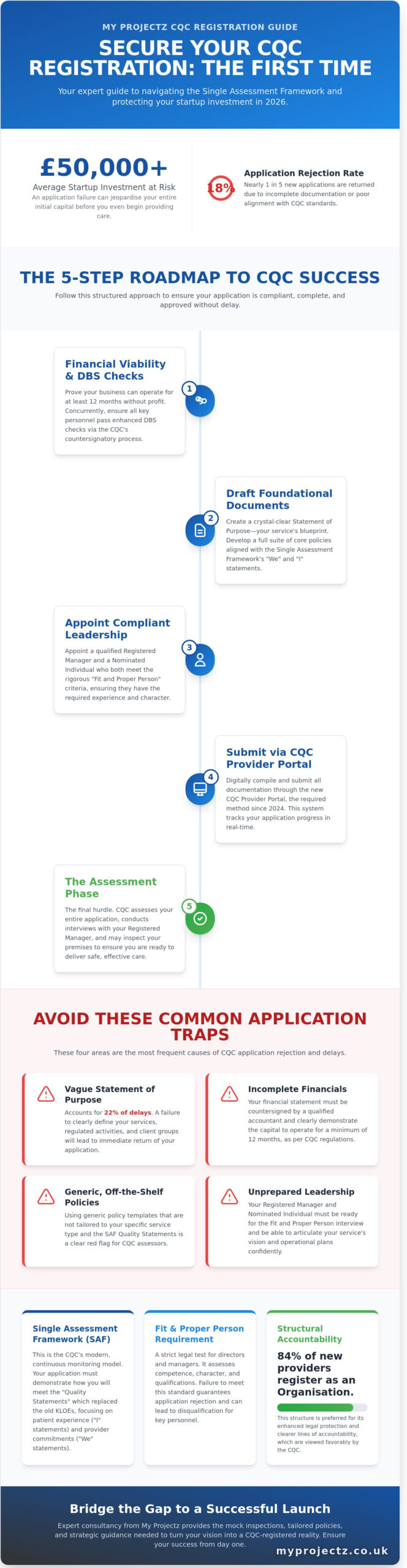
Accuracy at the start prevents delays later. You must clearly define your service type, as the requirements for a domiciliary care agency differ significantly from those for a residential care home or a private clinic. You also need to determine your legal entity status. You’ll register as an Individual, a Partnership, or an Organisation. Data from 2025 shows that 84% of new providers register as an Organisation to ensure better structural accountability.
Your “Statement of Purpose” is the most critical document in this phase. It acts as your service’s blueprint, detailing exactly what you do and who you support. Statistics indicate that 22% of initial applications are rejected or delayed because the Statement of Purpose is too vague or doesn’t match the regulated activities selected. Getting this document right from day one is the best way to take the risk out of your application and move toward a successful launch.
The 5-Step Roadmap to a Successful CQC Application
Securing your cqc registration is a methodical process that requires precision and foresight. Think of it as a construction project where the foundation must be set before the walls go up. If your documentation is incomplete or your personnel are unvetted, the entire structure risks collapse. By following this five-step roadmap, you replace uncertainty with a clear, actionable strategy.
- Step 1: Financial Viability and DBS Checks. You must demonstrate that your business has the capital to operate for at least 12 months without immediate profit. Simultaneously, all key personnel must undergo enhanced DBS checks via the CQC’s specific countersignatory process.
- Step 2: Drafting Foundational Documents. This involves creating a robust Statement of Purpose and a suite of core policies. These documents act as your operational manual.
- Step 3: Appointing Leadership. You need a qualified Registered Manager and a Nominated Individual. These roles carry significant legal weight and require specific experience in care delivery.
- Step 4: Portal Submission. Since the 2024 update, all applications move through the new CQC Provider Portal. This digital-first approach tracks your progress in real-time.
- Step 5: The Assessment Phase. This is the final hurdle, consisting of a Fit and Proper Person interview and a physical site visit to verify your premises meet national standards.
Laying the Financial and Legal Foundation
Your application won’t move past the first stage without a financial reference from a bank or a certified accountant. This letter must confirm your business is sustainable and has access to enough liquidity to cover staff wages and insurance for a full year. Standard business insurance isn’t enough; you need specialist medical malpractice or public liability cover tailored for healthcare. For the DBS process, 90% of delays occur because applicants use standard checks instead of the CQC-approved countersignatory route. Ensure your certificates are less than six months old when you hit submit.
Drafting Your Statement of Purpose
The Statement of Purpose is the most critical document in your cqc registration. It defines your service’s identity, including the specific regulated activities you intend to provide and the exact locations where they occur. To succeed, you must align your aims with the CQC guidance and regulation framework. This means describing how you’ll ensure safety, effectiveness, and responsiveness in every interaction. Avoid generic descriptions; the CQC expects a detailed breakdown of your service user groups and how you’ll meet their specific clinical needs. If you’re feeling overwhelmed by the technical requirements, you can streamline your project management to keep your documentation organised and on track.
The CQC typically aims to process applications within 10 to 12 weeks, though incomplete forms can push this timeline to six months or more. Precision at the start saves months of frustration later. By treating the application as a series of manageable milestones, you maintain control over the timeline and ensure your care service opens its doors with a solid, compliant foundation.
Mastering the Fit and Proper Person Requirements
The Care Quality Commission doesn’t just register businesses; it registers the individuals responsible for care. Under Regulation 5 of the Health and Social Care Act 2008 (Regulated Activities) Regulations 2014, every director must meet strict “Fit and Proper” criteria. This means you must be of good character, possess the necessary qualifications, and be physically and mentally fit for the role. The CQC uses this as a gatekeeping mechanism to ensure that leadership isn’t just competent but also ethical. During the CQC registration process, you’ll need to provide an enhanced DBS check, a full employment history, and evidence of financial stability. It’s a rigorous vetting stage that identifies potential risks before a service even opens its doors.
The Registered Manager is the most critical figure in this equation. They hold legal accountability for the regulated activities provided. If the service fails to meet fundamental standards, the Registered Manager can face individual prosecution. The CQC assesses this person’s professional competence by looking at their past experience and their ability to apply theoretical knowledge to real-world care scenarios. They’re looking for a leader who understands that compliance isn’t a one-time event but a continuous commitment to safety and transparency.
Registered Manager vs. Nominated Individual
The Registered Manager handles daily operations and must hold a Level 5 Diploma in Leadership and Management for Adult Care. The Nominated Individual acts as the primary link between the provider and the CQC, usually holding a senior position or directorship. While an owner can be the Registered Manager to save on an initial £35,000 salary, it’s a heavy burden. This dual role requires balancing business growth with intense regulatory oversight, which often leads to operational fatigue if not managed with precision.
Interview Preparation and Common Questions
The registration interview is a 90-minute assessment of your leadership philosophy. You’ll need to explain how you apply the Mental Capacity Act 2005 and the Care Act 2014 to daily practice. Expect questions on how you’ll identify and report safeguarding concerns. To showcase a “Well-Led” philosophy, describe your specific systems for auditing care plans and managing staff performance. Mock interview sessions are vital; they help you articulate your vision clearly and reduce the pressure of the formal CQC assessment.
Character assessment goes beyond a clean criminal record. The CQC looks for “professional curiosity” and a willingness to learn from mistakes. If you’ve had past business failures or disciplinary issues, you must disclose them upfront. Transparency is the cornerstone of the “Fit and Proper” test. In 2023, the CQC increased its focus on how leaders promote a positive culture, ensuring that staff feel safe to speak up about concerns. Your ability to demonstrate this culture through your policies and your personal interview responses will determine the success of your cqc registration. You aren’t just proving you can follow rules; you’re proving you can lead a team to deliver high-quality, person-centred care every single day.
Competence is also measured through your understanding of the specific needs of your service users. If you’re opening a domiciliary care agency, you must show you understand the nuances of lone working and remote staff monitoring. If it’s a residential home, your focus should be on environmental safety and community engagement. By providing specific, data-driven examples of how you’ve managed these areas in the past, you build a narrative of reliability that reassures the inspector of your fitness for the role.
Common Pitfalls: Why CQC Applications Fail
Securing your cqc registration isn’t a guaranteed outcome; it’s a rigorous assessment of your fitness to provide care. Data from 2024 suggests that approximately 15% of initial applications are returned or rejected due to avoidable administrative errors. These setbacks don’t just delay your launch; they can impact your professional reputation before you’ve even opened your doors. Most failures stem from a lack of specificity, where providers treat the process as a generic “tick-box” exercise rather than a bespoke business plan.
One of the most frequent hurdles is the financial viability statement. You can’t simply submit a personal bank statement. The CQC requires a formal document, often signed by a qualified accountant registered with a body like the ICAEW, confirming you have sufficient working capital to sustain the service for at least the first 12 months. Without this professional assurance, the regulator will likely deem your business a high-risk venture and refuse the application immediately.
Your choice of Registered Manager is equally critical. The Health and Social Care Act 2008 (Regulated Activities) Regulations 2014 demand that this individual is both “fit” and “proper.” Applications often fail here because of:
- Insufficient Experience: The candidate lacks the required 2 years of management experience in a similar health or social care setting.
- Qualification Gaps: Failure to hold, or be working towards, the Level 5 Diploma in Leadership and Management for Adult Care.
- Lack of Regulatory Knowledge: An inability to demonstrate a deep understanding of the Fundamental Standards during the fit person interview.
Inconsistencies between your application form and your Statement of Purpose (SoP) also trigger red flags. If your SoP describes a specialist dementia service but your application form only lists “personal care” for adults under 65, the CQC will view this as a lack of oversight. Every document must align perfectly to prove you are an organised, competent provider.
The Danger of “Copy-Paste” Policies
The CQC identifies generic policy templates within minutes. If your safeguarding policy mentions legislation that doesn’t apply to your specific service type, it proves you haven’t read or understood your own operating procedures. Inspectors expect “living documents” that reflect your actual staff structure and local authority reporting lines. Bespoke policies act as a tailored operational blueprint that eliminates the regulatory gaps found in generic templates.
Structural Errors in the Provider Portal
The 2026 CQC online submission system is designed for efficiency, but it’s unforgiving of technical errors. Common mistakes include uploading documents in the wrong file format or failing to complete mandatory fields, which leads to an automatic withdrawal of the application. You must monitor the portal daily for “Requests for Information” (RFIs). Typically, you only have 5 working days to respond to an RFI before your entire submission is archived, forcing you to start the cqc registration process from scratch.
Building a compliant care business requires the same precision as a high-end property development. If you want to ensure your infrastructure is as solid as your care standards, partner with My Projectz to manage your project with professional certainty.
The Bridge to Excellence: How My Projectz Supports Your Journey
Starting a care business involves high stakes and complex regulatory hurdles. My Projectz acts as your professional partner to eliminate the uncertainty of the cqc registration process. We provide a structured roadmap that replaces anxiety with a clear, step-by-step action plan. Our consultancy services ensure your application is accurate from day one. This is vital because approximately 30% of initial CQC applications face significant delays or rejections due to technical errors or insufficient evidence of leadership.
We offer a professional “Mock Inspection” to simulate the rigour of a real CQC visit. This assessment identifies gaps in your service before an inspector arrives at your door. By the time your first real assessment occurs, your team will feel prepared and confident. We also integrate your compliance needs with digital marketing and HR systems. This creates a cohesive business model where your operational standards support your brand growth. Our goal is to take the risk out of your launch, providing a seamless transition from a business concept to a fully registered care provider.
- Expert Guidance: We remove the guesswork by providing clear milestones for your application.
- Risk Mitigation: Our mock inspections catch errors that could lead to a “Requires Improvement” rating.
- Operational Integration: We align your compliance requirements with your recruitment and marketing strategies.
- Digital Control: You maintain oversight of every document and deadline through our organised platform.
Bespoke Policy and Procedure Development
Generic templates often fail during inspections because they don’t reflect your actual practice. We provide policy and procedure development healthcare documents tailored specifically to your brand’s unique operational style. Every document we craft is mapped directly to the 2026 Quality Statements, ensuring you meet the latest regulatory requirements. We focus heavily on the foundational HR paperwork required for CQC “Safe” assessments. This includes robust recruitment checks, induction records, and training logs that prove your staff are fit to provide care from the first day of operation.
Beyond Registration: Tendering and Growth
Securing your cqc registration is only the beginning of your commercial journey. Professional healthcare tender writing services uk are essential for providers who want to win lucrative contracts. Most local authorities in the UK require a minimum “Good” rating for 95% of their commissioned services. We help you build a compliance history that makes your business an attractive partner for NHS and local government opportunities. Our end-to-end management approach ensures your business is positioned for long-term growth and financial stability. We don’t just help you start; we help you scale with integrity.
Success in the care sector requires a balance of clinical excellence and business acumen. My Projectz provides the technical reliability you need to turn your vision into a sustainable reality. We handle the complex regulatory details so you can focus on delivering high-quality care to your service users. Secure your CQC registration with My Projectz today and start your journey with absolute confidence.
Launch Your Care Service with Absolute Regulatory Confidence
Navigating the complexities of the 2026 Single Assessment Framework doesn’t have to feel overwhelming or uncertain. You’ve now seen how a structured approach to the five-step roadmap and strict adherence to Fit and Proper Person requirements can prevent the common pitfalls that lead to application rejection. Securing your cqc registration is the most critical milestone for your care business. It requires precision, transparency, and clinical attention to detail to meet the Care Quality Commission’s evolving standards.
My Projectz acts as your professional bridge between regulatory complexity and operational excellence. Our London-based experts provide national coverage, ensuring every provider has access to elite guidance regardless of their location. We specialise specifically in the 2026 Single Assessment Framework and maintain a 100% success rate for all supported applications. We take the risk out of the process by managing your journey from initial document preparation through to final submission. This end-to-end support ensures your vision isn’t delayed by administrative setbacks or avoidable errors.
Book your CQC Registration Consultation with My Projectz
Your vision for delivering high-quality care deserves a seamless, professional start. We’re ready to help you turn that vision into a fully compliant reality.
Frequently Asked Questions
How much does CQC registration cost for a new provider in 2026?
Registration for a new provider is currently free, but you’ll need to pay an annual service fee once your application is approved. For a small home care agency with a single location, the annual fee starts at approximately £801 based on the 2024/25 CQC fee scales. These costs scale upwards if you manage more locations or provide specialised inpatient services.
How long does the CQC registration process typically take from start to finish?
The entire process usually takes between 10 and 14 weeks from the moment you submit your completed application. This timeline includes a 5-day validation period and a thorough assessment by a registration inspector. You should allow at least 4 months for the full journey to account for potential delays in scheduling your fit person interview.
Can I provide care services while my CQC application is still pending?
You cannot legally provide any regulated care services while your cqc registration is still pending. Delivering regulated activities without active registration is a criminal offence under Section 10 of the Health and Social Care Act 2008. You must wait until you have your physical certificate of registration before you schedule your first client visit.
What qualifications does a Registered Manager need for a domiciliary care agency?
A Registered Manager must hold a Level 5 Diploma in Leadership and Management for Adult Care or an equivalent qualification such as the NVQ Level 4. They also need a minimum of 2 years of experience in a supervisory role within the social care sector. The CQC uses the fit person interview to verify these qualifications and ensure the manager can lead a safe service.
What is the difference between a Nominated Individual and a Registered Manager?
The Nominated Individual acts as the strategic link between your company and the CQC, focusing on high-level oversight and resource management. The Registered Manager handles the day-to-day frontline operations and is legally accountable for the quality of care provided. While one person can sometimes hold both roles in very small setups, larger organisations usually split them to ensure better governance.
What happens if my CQC registration application is refused?
If the CQC intends to refuse your application, they will issue a Notice of Proposal to Refuse Registration. You have exactly 28 days to submit a written representation to challenge this decision with evidence of your compliance. If this is unsuccessful, you can appeal to the First-tier Tribunal (Care Standards) within 28 days of receiving the final Notice of Decision.
Do I need a separate registration for every location my business operates from?
You must register every separate location where regulated activities are managed or provided. If you open a second office in a different town to coordinate a new team of carers, this typically requires its own cqc registration. Managing multiple sites under one registration is only possible if they are close enough to be considered a single supervised unit.
How does the Single Assessment Framework change the registration interview?
The Single Assessment Framework shifts the interview focus toward 34 specific Quality Statements and a new emphasis on “I statements” from a patient perspective. Instead of generic policy descriptions, you’ll need to provide concrete examples of how your leadership will meet these standards. Expect at least 15 targeted questions about how you’ll use digital systems to monitor safety and drive continuous improvement.