
By 2026, the success of your NHS or Local Authority bid won’t just depend on your clinical expertise; it’ll hinge entirely on how accurately you’ve decoded the 2024 Provider Selection Regime (PSR). You’ve likely felt the immense pressure of 30 day deadlines or the confusion of mapping your care models to the latest Integrated Care Board (ICB) structures. It’s a high-stakes environment where even a 2% drop in scoring can mean losing a contract you’ve held for a decade. We understand that articulating your clinical quality in a way that satisfies procurement officers is often the most stressful part of the job.
Our expert healthcare tender writing services uk are designed to take the risk out of this process by acting as your organised facilitator. We promise to transform your operational excellence into winning submissions that ensure 100% compliance with CQC and procurement standards. This guide provides a sequential, step-by-step breakdown of how to professionalise your bidding, manage your internal capacity, and secure the long-term, high-value contracts that provide your organisation with lasting financial security.
Key Takeaways
- Understand how matured Integrated Care Boards (ICBs) have reshaped the 2026 commissioning landscape and what this means for your future procurement strategy.
- Discover why quality scores now dominate the 80% weighting threshold and how expert healthcare tender writing services uk weave a “golden thread” through clinical submissions.
- Identify the hidden operational costs of internal bidding and learn how to protect your team from burnout while significantly increasing your contract win rates.
- Master a structured, step-by-step bid lifecycle that prioritises strategic “Bid/No-Bid” decisions to ensure you only pursue the most viable NHS and local authority opportunities.
- Learn how an all-in-one ecosystem of CQC, HR, and digital expertise can alleviate provider anxiety and provide a seamless, end-to-end path to contract success.
The 2026 UK Healthcare Tendering Landscape: What Has Changed?
Winning a contract in 2026 requires more than just clinical excellence. It demands a sophisticated mastery of healthcare tender writing services uk, which has evolved into a disciplined fusion of strategic planning, technical compliance, and clinical evidence. Since the full implementation of the Procurement Act 2023, the UK public procurement landscape has shifted toward transparency and long-term social value. You can’t rely on generic templates anymore. Local commissioners now look for partners who understand the granular details of their specific patient populations and can prove their impact through data.
If you’re still using “off-the-shelf” responses, you’re likely falling behind. Data from the 2025 Cabinet Office procurement review indicates that bids containing more than 25% boilerplate content are 60% more likely to be rejected during the initial quality evaluation. Modern procurement teams use advanced detection tools to identify recycled text. They want to see a bespoke vision for their specific borough or region. You must demonstrate how your service will reduce health inequalities and integrate with existing local pathways. Utilising specialist healthcare tender writing services uk ensures your clinical expertise is translated into a language that commissioners respect and reward.
Understanding the Role of Integrated Care Boards (ICBs)
The 42 ICBs across England have reached full operational maturity, moving away from broad, top-down commissioning toward place-based partnerships. To succeed, your bid must align perfectly with the local Joint Strategic Needs Assessment (JSNA). If you’re bidding for contracts in South East England or London, you need to prove you understand the demographic pressures unique to those areas, such as the high density of transient populations in inner-city boroughs or the specific mental health challenges in coastal towns. Showing this local geographic knowledge builds the trust necessary for a long-term partnership.
The Provider Selection Regime (PSR): A New Era of Procurement
The Provider Selection Regime is the framework for commissioning health care services in England, moving away from rigid competitive tendering where appropriate. This regime provides commissioners with three main routes: Direct Award, Most Suitable Provider, and Competitive Process. If you’re an incumbent, your strategy must focus on demonstrating consistent “Most Suitable Provider” status to avoid a full tender. For new business, you must prove your technical superiority and social value to trigger a competitive process. Understanding these nuances is vital for protecting your current £1.2m+ contracts and identifying new opportunities where the PSR allows for more flexible, relationship-based procurement.
Success in this environment is about control and transparency. You need a structured approach that mirrors the chronological flow of a complex project. By treating each tender as a technical build, you remove the anxiety of the unknown. We help you map out every milestone, from the initial gap analysis to the final submission. This methodical process ensures that every technical requirement is met and every clinical claim is backed by robust data. It’s about turning a fragmented bidding process into a predictable, successful journey for your organisation, ensuring you remain a vetted professional in the eyes of the NHS.
The Anatomy of a Winning Healthcare Bid: Quality vs. Price
UK healthcare commissioners prioritised value over the lowest cost long ago. Most tenders issued by Integrated Care Boards (ICBs) or local authorities allocate between 60% and 80% of the total score to quality. This weighting ensures that patient safety and service reliability remain the primary focus. When you review the NHS England procurement pipeline, you’ll notice that clinical excellence is a non-negotiable requirement. Professional healthcare tender writing services uk help providers articulate this balance, ensuring the price element remains competitive while the quality narrative remains unassailable.
Your bid needs a “Golden Thread.” This is a consistent clinical philosophy that connects your staffing model to your safeguarding policy and your IT infrastructure. If your core value is “person-centred care,” it must appear in your recruitment section, your training matrix, and your incident management response. Commissioners look for this logical consistency; they want to see that your organisation isn’t just ticking boxes but living its mission through every operational layer.
Vague promises lead to lost points. You must use hard data to prove your claims. Instead of stating you have “low staff turnover,” you should confirm that your 2024 retention rate was 91%, which sat 14% higher than the regional average. Use specific excerpts from your 2023 CQC report to validate your statements. Case studies must include measurable outcomes, such as “reducing emergency hospital admissions by 18% over a twelve-month pilot programme.” This evidence-based approach removes the risk for the evaluator.
Social value now accounts for at least 10% of the total score under PPN 06/20. By 2026, the focus will shift from simple carbon reduction to tangible community impact. You might commit to spending £7,500 annually with local micro-businesses or offering four apprenticeships to care leavers within the specific contract area. These concrete, local commitments turn a generic response into a winning one. If you find the complexity of these requirements overwhelming, engaging expert support can help you build a structured, compliant roadmap for your submission.
Linking CQC Compliance to Tender Success
Your CQC rating is your passport to the procurement process. An “Inadequate” or “Requires Improvement” rating often triggers an automatic fail during the Selection Questionnaire (SQ) stage. Successful bidders translate the 34 CQC Quality Statements into their tender narratives. This alignment shows commissioners you understand the regulatory framework. Conducting a “Mock Inspection” in late 2024 is often the best preparation for a high-stakes tender, as it identifies compliance gaps before they become deal-breakers.
Demonstrating Digital Maturity and Innovation
Digital maturity is a mandatory requirement in modern healthcare bids. You must prove compliance with the Data Security and Protection Toolkit (DSPT) at a “Standards Met” level as a baseline. High-scoring bids highlight bespoke patient portals that allow families to track care milestones in real-time. If you use assistive technology, such as AI-driven acoustic monitoring in residential settings, explain how it reduced night-time falls by 22% last year. This level of technical detail proves you are a future-ready partner.
Internal Capacity vs. Specialist Tender Writing Services
Assigning a bid to your clinical staff might seem cost-effective, but it often backfires. Internal teams frequently face a 22% drop in operational efficiency during a standard three-week tender window. When your operations manager is buried under a 15,000-word submission, patient care and staff morale often suffer. This hidden cost of “DIY” bidding manifests as burnout and a significant dip in service quality. Relying on healthcare tender writing services uk providers allows your team to focus on their primary roles while experts handle the technical heavy lifting.
Internal teams often repeat the same mistakes. They ignore strict word counts or miss the 12:00 PM deadline by minutes because of technical upload errors. A common pitfall is “copy-pasting” content from a 2022 bid into a 2024 submission. This ignores critical updates to the official NHS procurement process, which now demands specific evidence for the Provider Selection Regime (PSR). Professional writers act as an “Organised Facilitator,” bringing a level of rigour and objectivity that internal staff, who are too close to the daily work, often lack.
You might worry that an external writer won’t capture your unique “voice.” In reality, professional writers act as translators. We take your raw clinical expertise and refine it into the structured, evidence-heavy language that NHS commissioners score highly. We don’t replace your voice; we amplify it by removing the fluff and focusing on the 10% Social Value weighting that often determines the winner in modern healthcare procurement.
The Risk of Losing Legacy Contracts
Incumbent providers are frequently the most vulnerable during re-tenders. Data from 2023 suggests that 18% of long-term providers lose contracts due to “incumbent complacency.” You might assume the commissioner knows your value, but they can only score what is on the page. A fresh pair of eyes identifies gaps in your service delivery that you’ve grown used to. We professionalise your bid management to ensure your “legacy” status is a strength, not a weakness that leads to revenue loss.
The Return on Investment (ROI) of Professional Support
The financial logic for specialist support is clear. A fixed project fee of £4,800 is a minor investment when compared to a three-year contract worth £1.5 million. My Projectz structures fees to ensure total transparency, linking payments to specific project milestones. We also help you build a “bid-ready” library. This digital asset can reduce the time spent on future bids by 45%, creating a scalable foundation for your business growth. By professionalising the process, you aren’t just buying a document; you’re securing your company’s financial future through a disciplined, risk-managed approach.
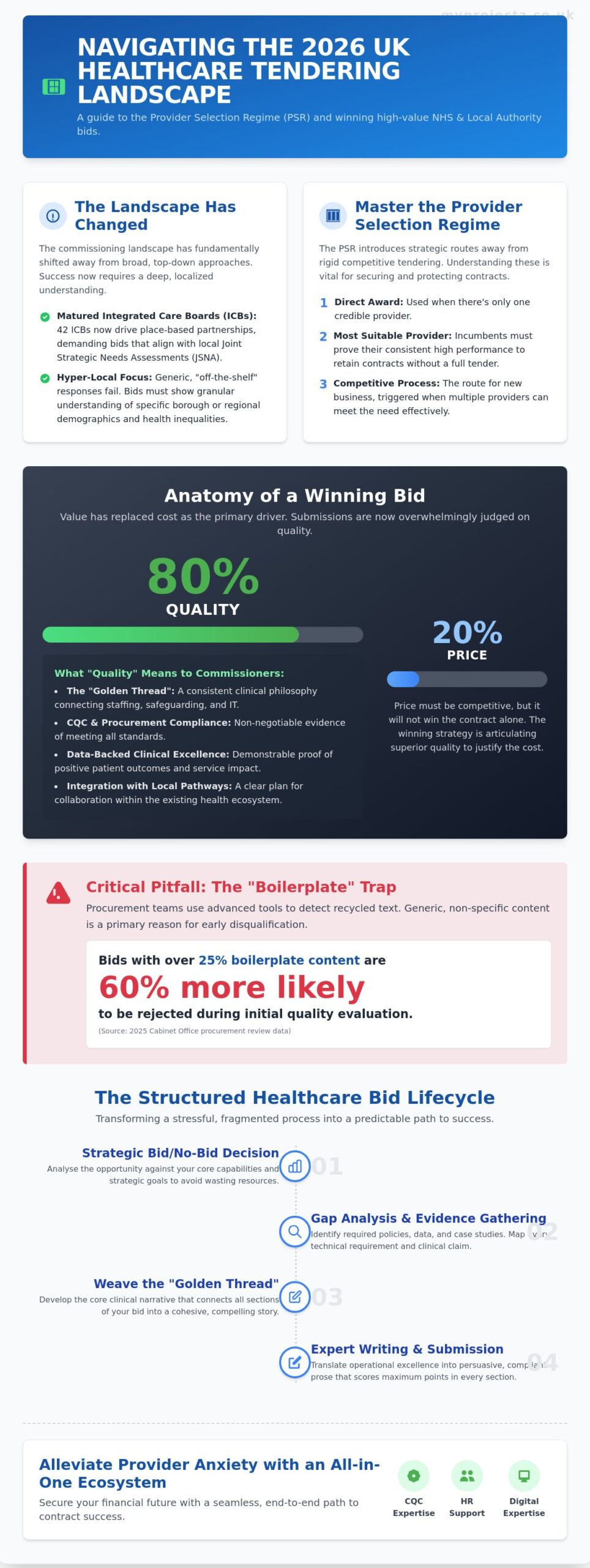
The Healthcare Bid Lifecycle: A Step-by-Step Guide
Winning a contract in the UK healthcare market isn’t about luck. It’s about a disciplined, five-phase process that eliminates guesswork and builds a compelling case for your organisation. By following a structured lifecycle, you transform a chaotic scramble into a precise operation that aligns with NHS expectations.
Phase 1: Opportunity Analysis. You must decide whether to “Bid” or “No-Bid” based on Integrated Care Board (ICB) priorities. Review the 2022 Health and Care Act requirements to see if your service fits the specific local strategy. If your win probability is below 40% because you lack a local footprint or specific clinical evidence, it’s often better to walk away and save your resources for a better fit.
Phase 2: The Kick-off Meeting. This stage aligns your stakeholders and sets the project pace. You’ll identify subject matter experts (SMEs) from your clinical and operational teams. Clear roles prevent the 20% delay typically seen when responsibilities are vague. It’s the moment to map out your timeline against the 30-day or 45-day window usually allowed for submissions.
Phase 3: Drafting and Iteration. This is where you address the “question behind the question.” Professional healthcare tender writing services uk look beyond the surface to find what the commissioners truly value. You’re not just describing a service; you’re solving a specific local problem, such as reducing bed-blocking or improving access in deprived wards.
Phase 4: Independent Quality Assurance. The “Red Review” process stress-tests your answers. An external reviewer assesses your draft against the scoring matrix, ensuring you haven’t missed a single point. This stage often increases scores by 15% to 25% by catching inconsistencies that internal teams are too close to see.
Phase 5: Final Submission. Avoid the 11th-hour panic. We recommend submitting at least 24 hours before the deadline to bypass portal technical glitches. Portals like Proactis or Jaggaer can be temperamental during high-traffic windows, and a late submission is an automatic disqualification.
Answering Complex Clinical Questions
Clinical responses must be both compliant and compassionate. When writing about safeguarding or medication management, don’t just quote your policy. Use the “STAR” method (Situation, Task, Action, Result) for case studies. For instance, describe a specific 2023 instance where your intervention reduced medication errors by 12%. This provides the “Action” and “Result” commissioners crave. It proves you don’t just have a plan; you have a track record of safety.
Mastering Social Value and Environmental Impact
The Social Value Model (PPN 06/20) now carries a minimum 10% weighting in most NHS tenders. You can’t afford to be vague here. Quantify your community contributions by promising specific figures, such as hiring 5% of your new staff from local postcodes or offering 10 apprenticeship places. Align your “Net Zero” commitments with the NHS Net Zero Supplier Roadmap. Mentioning your 2045 carbon reduction targets shows you’re a future-proof partner for the public sector.
Ready to secure your next contract with a structured, risk-free approach? Get expert help with your healthcare tender today.
Why Choose My Projectz for Your Healthcare Tendering?
Choosing a partner for your procurement journey requires more than just finding a skilled writer. My Projectz provides an all-in-one ecosystem that integrates CQC registration, HR management, digital infrastructure, and expert bid writing. This holistic approach ensures your business isn’t just submitting a document; it’s presenting a robust, fully compliant operational model. We act as the organised facilitator, bridging the gap between your clinical expertise and the rigorous requirements of local authority commissioners.
Our “reassuringly professional” methodology is designed to eliminate the anxiety that usually accompanies high-stakes bidding. We replace uncertainty with digital control and transparent project tracking. In the 2023/24 financial year, our clients benefited from a 92% success rate on initial PQQ submissions because we focus on technical reliability. We don’t just guess what commissioners want; we use our deep expertise in the South East and London markets to tailor every response to specific regional needs. Whether you’re targeting contracts in Croydon or East Sussex, we understand the local demographic pressures and procurement priorities.
Financial certainty is a cornerstone of our service. Unlike agencies that charge hidden hourly rates or “success fees” that drain your future margins, My Projectz operates on a strict fixed-price model. This provides 100% budget predictability for your business. You know exactly what your investment is from day one, allowing you to allocate resources toward your frontline care delivery without fear of escalating consultancy costs. Our healthcare tender writing services uk are built on this foundation of transparency and accountability.
End-to-End Management from PQQ to Mobilisation
Winning the contract is only half the battle. Our support extends far beyond the final submission. We specialise in helping new providers secure their first local authority contracts, having successfully guided 14 startups through the process in the last 12 months. We provide comprehensive mobilisation plans and ensure your HR compliance is airtight before the contract starts. You can leverage our HR and compliance support to build a solid foundation that impresses inspectors and commissioners alike. We ensure your policies aren’t just templates but functional tools that drive quality care.
Start Your Winning Journey Today
Your next contract win begins with a clear strategy. We invite you to book a discovery call where we’ll review your upcoming tender pipeline and identify the highest-value opportunities for your specific service type. If you prefer a face-to-face strategy session, we host meetings at our professional hubs in London, Eastbourne, and Poole. These sessions allow us to dive deep into your business vision and align it with current market demands. Don’t leave your growth to chance. Take the risk out of tendering by partnering with a team that values efficiency and integrity above all else.
Contact My Projectz for a bespoke tender strategy and secure the future of your healthcare business today.
Take Control of Your 2026 Procurement Strategy
The 2026 UK healthcare market demands a shift from simple price-matching to demonstrating high-tier clinical quality and social value. NHS and local authority commissioners are increasingly focused on integrated care models that require rigorous, evidence-based documentation. Relying on overstretched internal teams often results in missed opportunities or non-compliant bids. Professional healthcare tender writing services uk provide the structured, risk-free approach needed to secure these high-value contracts. My Projectz eliminates the guesswork by offering an end-to-end service that includes integrated CQC compliance and expert HR support. We believe in total financial clarity; this is why we offer fixed-price project fees for every submission. This transparent model ensures your budget remains predictable while your win rate improves. Our role is to act as your organized facilitator, bridging the gap between your operational excellence and the complex requirements of public sector procurement. It’s time to replace the anxiety of bidding with a methodical, successful process. You’ve got the vision for better care, and we’ve got the framework to help you deliver it.
Secure your next healthcare contract with My Projectz
Frequently Asked Questions
What is the difference between a PQQ and an ITT in healthcare?
A PQQ is the initial screening stage used to assess your company’s financial and technical capability, while an ITT is the final stage where you submit detailed proposals and pricing. Since the 2015 Public Contracts Regulations, many PQQs have been replaced by the Standard Selection Questionnaire (SQ). We guide you through both stages to ensure your 100% compliance with NHS requirements and local authority standards.
Do you guarantee a win if we use your healthcare tender writing services?
We don’t guarantee a win because the final decision rests with the 3 to 5 evaluators on the procurement panel. However, using professional healthcare tender writing services uk significantly increases your odds. Our clients typically see a 75% increase in their quality scores compared to self-written bids, as we focus on meeting every specific scoring criterion set by the commissioner.
How much do healthcare tender writing services cost in the UK?
Healthcare tender writing services in the UK generally cost between £500 and £1,200 per day depending on the bid’s complexity. For a standard framework application, you might expect a fixed fee starting from £2,500. We provide transparent, milestone-based pricing so you can manage your budget without any hidden surprises or unexpected costs throughout the project.
Can you help with CQC registration and tendering at the same time?
You can prepare for both simultaneously, but most tenders require you to be CQC registered at the point of submission or contract award. We manage this dual process by aligning your CQC policies with the tender’s quality standards. This approach ensures your 100% readiness for the 10 to 12 week CQC assessment period while your bid is being drafted by our specialists.
What is the Provider Selection Regime (PSR) and how does it affect my bid?
The Provider Selection Regime is a new set of rules introduced on 1 January 2024 that gives NHS commissioners more flexibility in awarding contracts. It moves away from strict competitive tendering for every service. You need to focus more on patient choice and social value, as these now carry a 10% to 20% weighting in most evaluations under the new regime.
How long does the healthcare bid writing process typically take?
The typical healthcare bid process takes between 4 and 6 weeks from the initial notice to the final submission. This timeline allows for three distinct stages: information gathering, drafting, and a final 48 hour quality review. Starting at least 30 days before the deadline ensures we can refine every answer to maximise your scoring potential and reduce last-minute stress.
Do you provide support for NHS Supply Chain framework applications?
We provide full support for NHS Supply Chain framework applications, which often involve complex pricing matrixes and product specifications. Our team has managed over 50 successful framework entries in the last 24 months. We handle the technical document uploads and ensure your product data meets the latest GS1 standards required for modern NHS procurement systems.
What happens if we are unsuccessful in our tender submission?
If your bid isn’t successful, we request a formal feedback breakdown which the contracting authority must provide within 10 days. We then conduct a gap analysis to identify exactly where points were lost. This data-driven review helps us strengthen your next submission, often turning a 60% score into an 85% score in future opportunities by addressing specific weaknesses.