
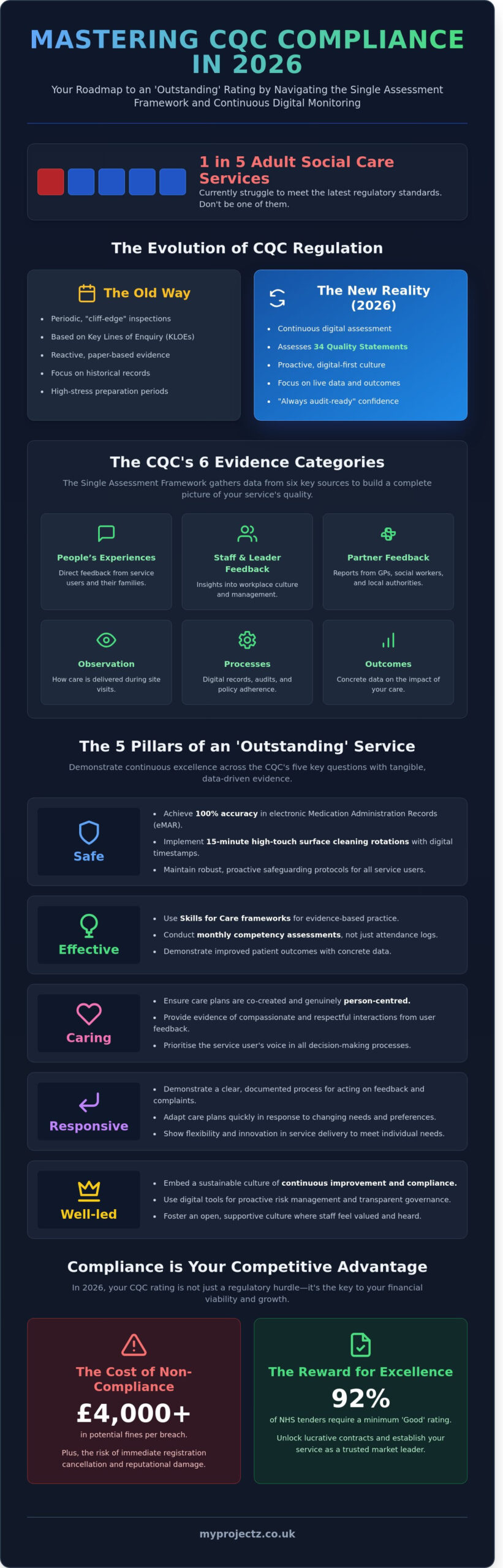
In 2026, a “Good” CQC rating isn’t just a badge of quality; it’s the only currency that matters for your service’s survival. With the Care Quality Commission now assessing 34 quality statements through a continuous monitoring lens, mastering care compliance is no longer a periodic task but a daily necessity. You likely feel the weight of this shift, especially when 1 in 5 adult social care services currently struggle to meet the latest regulatory standards. It’s exhausting to manage the administrative burden of evidence collection while trying to keep your policies aligned with rapidly changing UK legislation.
We’re here to take the risk out of your regulatory journey. You’ll learn how to build a robust, digital-first culture that secures your rating and helps you win lucrative local authority and NHS tenders. This guide provides a methodical, step-by-step roadmap to master the Single Assessment Framework and transform your compliance from a source of stress into a powerful competitive advantage. We’ll show you how to streamline your evidence collection and ensure your team is always audit-ready.
Key Takeaways
- Navigate the transition from periodic inspections to continuous digital assessment under the CQC Single Assessment Framework.
- Identify the specific evidence required to achieve an “Outstanding” rating across the five key pillars of quality and safety.
- Uncover the common blind spots in internal audits and learn how professional mock inspections provide the rigour needed to protect your rating.
- Build a sustainable culture of care compliance by embedding “live” policies and proactive training into your team’s daily routines.
- Learn how to leverage your quality data as a strategic asset to win lucrative NHS and local authority tenders.
What is Care Compliance in 2026? Navigating the Single Assessment Framework
Care compliance in 2026 is no longer a reactive process or a seasonal hurdle. It’s the proactive, continuous alignment of your service with the Care Quality Commission (CQC) fundamental standards and the Single Assessment Framework (SAF). You should view it as a live project management dashboard for your facility. You’ve moved away from “preparing for inspection” and transitioned into a state of “living in compliance.” This shift ensures that every action your team takes is documented, verified, and ready for scrutiny at any moment.
The core of this modern care compliance model is the replacement of the old Key Lines of Enquiry (KLOEs) with “Quality Statements.” These are specific “we” statements that describe what a high-quality service looks like. Unlike the previous system, these statements don’t just ask if you have a policy; they demand evidence of the outcomes that policy produces. In 2026, the regulator prioritises real-time data over historical records. This means your business viability depends on your ability to provide a transparent, digital trail of safety and effectiveness. It’s about replacing the uncertainty of traditional inspections with the calm confidence of digital control.
To succeed, you must embrace the “continuous assessment” model. The CQC now monitors services through six categories of evidence:
- People’s experiences: Direct feedback from service users and their families.
- Feedback from staff and leaders: Insights into the culture and management of the home.
- Feedback from partners: Reports from GPs, social workers, and local authorities.
- Observation: How care is delivered on the ground during site visits.
- Processes: Your digital records, audits, and policy adherence.
- Outcomes: Concrete data showing the impact of your care on patient health.
The Evolution of CQC Regulation
The transition to the Single Assessment Framework, which began in January 2024, reached full maturity this year. The CQC now prioritises “people’s experiences” over paper-based policies. You must use the provider portal for real-time compliance reporting. This digital-first approach ensures that the regulator sees a consistent flow of evidence rather than a snapshot from a single day. It’s an end-to-end management system that removes the “cliff-edge” anxiety of old-style inspections.
Why “Good Enough” is No Longer Enough
Maintaining a “Good” or “Outstanding” rating is essential for your bottom line. Data from 2025 shows that 92% of NHS continuing healthcare contracts now require a minimum “Good” rating to bid. The CQC uses automated data-driven monitoring to trigger unannounced inspections if your performance metrics dip. Non-compliance isn’t just a reputational risk; it carries heavy financial penalties. Fines often exceed £4,000, and persistent failures can lead to the immediate cancellation of your registration.
The 5 Pillars of Care Quality: Evidence and Excellence
The Care Quality Commission (CQC) evaluates every provider through five central questions: Is the service Safe, Effective, Caring, Responsive, and Well-led? These pillars anchor the CQC Quality Statements, creating a rigid yet transparent framework for care compliance. By 2026, an “Outstanding” rating is no longer about a single successful inspection day. It requires a continuous demonstration of excellence through live data, proactive risk management, and a culture that prioritises the service user’s voice above all else.
Safe and Effective: The Clinical Core
Safety in a modern care setting hinges on precision in medicine management and robust safeguarding. You must maintain 100% accuracy in electronic Medication Administration Records (eMAR) to eliminate dosage errors and ensure accountability. Effective care is evidence-based practice that improves service user outcomes. To reach the highest standards, you must move away from simple training attendance logs. Instead, use Skills for Care frameworks to conduct monthly competency assessments. This ensures your team possesses the practical skills to handle complex clinical needs safely. Infection control protocols should include 15-minute high-touch surface cleaning rotations during high-traffic periods, backed by digital timestamps to prove compliance.
Caring and Responsive: The Human Element
Documenting “person-centred” care requires capturing the specific preferences that make a resident feel at home. If a service user prefers a 07:45 wake-up time or specific religious dietary requirements, your digital care plans must reflect these choices and track their consistent delivery. Managing complaints effectively transforms a potential grievance into a tool for growth. Aim to acknowledge 100% of feedback within 24 hours and resolve 94% of informal concerns within 5 working days. You must weave equality, diversity, and inclusion (EDI) into daily life. This includes celebrating diverse cultural holidays and providing communication aids for those with sensory impairments. This level of detail proves your service responds to the individual, not just the diagnosis.
Well-led: The Foundation of Governance
The Well-led pillar acts as the structural frame for your entire organisation. It’s the most vital component for sustaining care compliance because it dictates how every other pillar functions. Your Registered Manager must champion a culture of transparency and “duty of candour,” where mistakes are analysed openly to prevent recurrence. Robust governance requires a digital-first approach to risk. Use structured internal audits to identify trends, such as a 5% increase in falls, before they become systemic failures. You can find detailed templates for these processes in our guide on Healthcare HR & Compliance Essentials: A UK Guide. Clear leadership ensures every staff member understands their role in the wider vision of the service, replacing uncertainty with operational confidence.
If you want to simplify your administrative burden, you can access our streamlined compliance templates to keep your records organised and audit-ready.
Internal Audits vs. Professional Mock Inspections: Which Do You Need?
Maintaining consistent care compliance requires a dual-track approach. While internal audits act as your daily safety net, professional mock inspections provide the high-stakes pressure test needed to secure a “Good” or “Outstanding” rating. Relying solely on your own team creates a “familiarity trap” where minor errors become invisible over time. In a 2024 survey of UK care providers, 68% of Registered Managers admitted that internal teams overlooked recurring documentation gaps simply because they had become part of the daily routine. A professional inspection removes this emotional bias, offering a cold, objective assessment of your service’s health.
The psychological shift during a mock event is profound. When an external consultant walks through the door, the atmosphere changes. It triggers a “rehearsal response” in staff, allowing them to practise their answers and demonstrate their knowledge under pressure. This reduces the anxiety often associated with the Care Quality Commission (CQC) visits. Instead of a day of dread, the real inspection becomes a performance your team has already mastered. It transforms the unknown into a manageable, predictable process.
The Limitations of Internal Auditing
Internal staff often face a conflict of interest. It’s difficult to flag a colleague’s failure when you share a break room every day. This social friction leads to “soft” reporting where serious issues are downplayed. There’s also a significant technical risk. Many providers are still using audit templates from 2022 or 2023. These outdated documents don’t reflect the 2026 Single Assessment Framework (SAF) or the latest evidence categories. Time constraints also play a role. Data shows that managers spend roughly 14 hours a week on reactive crisis management. This leaves little room for the deep-dive scrutiny required for a robust audit, often resulting in “tick-box” exercises that miss systemic risks.
The Value of an Independent Eye
Consultants from My Projectz simulate the exact CQC experience to identify hidden vulnerabilities before they become regulatory breaches. We don’t just look at files; we conduct “Fit and Proper Person” interview prep for directors and managers. This ensures leadership can articulate their vision and evidence their impact clearly. Our process transforms raw findings into a structured Quality Improvement Plan (QIP). This document acts as a prioritised roadmap, breaking down complex care compliance requirements into 15 to 20 manageable tasks. Presenting a proactive QIP to an inspector demonstrates a culture of transparency and continuous improvement, which is a key indicator of high-quality leadership. We take the risk out of the process by providing the digital control and professional oversight you need to succeed.
Building a Compliance Culture: HR, Training, and Policies
Compliance isn’t a static destination; it’s a daily discipline. To master care compliance in 2026, you must move beyond a “box-ticking” mindset. You need a culture where every staff member understands their role in safety and quality. This starts with a structured 5-step process to embed these values into your workforce’s DNA.
- Standardisation: Define clear, measurable expectations for every task.
- Digital Integration: Move policies from dusty ring binders into accessible, digital formats.
- Competency Validation: Shift from tracking “hours spent training” to assessing actual skills.
- Real-time Auditing: Use digital tools to spot gaps before they become CQC breaches.
- Agile Feedback: Update procedures immediately based on incident reports or legislative changes.
Policies that sit on a shelf are a liability. By 2026, the CQC expects “live” policies that reflect current best practices and the Single Assessment Framework. If your Medication Administration Record (MAR) policy hasn’t been reviewed since January 2025, it’s already outdated. Regular reviews ensure your team isn’t following obsolete guidance that could lead to an “Inadequate” rating. Digital platforms allow you to push updates to every staff member’s smartphone instantly, ensuring 100% policy awareness.
Staff morale and care compliance are deeply linked. Skills for Care data from 2024 showed a 28.3% turnover rate across the sector. High turnover creates a “compliance vacuum” where knowledge is lost. When you invest in robust systems, you reduce staff anxiety. People stay when they feel competent and supported by clear structures. This stability directly improves service user safety and your bottom line.
Recruitment and HR Compliance
Your compliance journey begins before a staff member’s first shift. You must maintain flawlessly organised records for DBS checks, professional references, and right-to-work documents. A digital HR dashboard eliminates the risk of missing an expiry date. Your staff handbook serves as the definitive guide for professional behaviour. If you are growing through acquisition, understanding TUPE Regulations Explained for Care Sector Mergers is vital for maintaining standards during transitions.
Continuous Professional Development (CPD)
Mandatory training is the bare minimum. To excel in 2026, focus on specialist skills like advanced dementia care or neurological rehabilitation. Use monthly supervisions and annual appraisals to track individual progress. This isn’t just about HR records; it’s about documenting how specific training sessions improved service user satisfaction scores or reduced falls by a specific percentage. For example, providers using proactive risk training in 2025 saw an average 15% reduction in reportable incidents. Digital tracking tools provide the transparency you need to prove your commitment to quality care.
Leveraging Compliance to Win Tenders and Grow Your Business
Care compliance isn’t just a regulatory hurdle; it’s the primary engine for your business growth. In the 2026 commissioning landscape, local authorities and NHS Integrated Care Boards (ICBs) have shifted towards a “quality-first” procurement model. This means your CQC rating is no longer just a badge on your website. It’s the entry ticket to the table. Data from 2024 indicates that 88% of local authority tenders in the South East now include a mandatory “Good” or “Outstanding” rating as a minimum threshold for participation. If your compliance isn’t documented and demonstrable, you’re effectively locked out of the most stable revenue streams in the sector.
From Compliance to Contract Winning
Commissioners use CQC data to vet potential providers long before the interview stage. They scrutinise your inspection history and the transparency of your digital audit trails to assess long-term risk. To win, you must transform your care compliance data into a compelling narrative of reliability. Use your Quality Improvement Plan (QIP) and recent audit results as hard evidence of “Social Value” and “Continuous Improvement.” These two categories often account for 15% to 20% of the total scoring weight in modern bids.
By showcasing how you’ve identified a deficiency and systematically corrected it, you prove to commissioners that your management is proactive. This level of detail separates successful bidders from those who provide generic, template-driven answers. For a deeper dive into these bidding mechanics, you should read our guide on how to Win More Healthcare Tenders: A Complete UK Guide to refine your strategy.
- Evidence-Based Bidding: Use specific percentages from your internal audits to answer “Quality” questions.
- Risk Mitigation: Show commissioners your “Near Miss” logs to demonstrate a culture of transparency.
- Social Value: Link your staff training compliance to local employment and skill-building targets.
Partnering with My Projectz
My Projectz offers a unique, dual-advantage partnership that bridges the gap between daily operations and commercial expansion. We understand that a Registered Manager is often too stretched to handle both a mock inspection and a complex 50,000-word tender submission. Our team provides the “Organised Facilitator” role, combining technical CQC consultancy with professional tender writing expertise to ensure your business is both compliant and competitive.
Our South East-based specialists provide hands-on, on-site support across London, Poole, and Brighton. We don’t just send you a checklist from a remote office. We walk your floors, interview your staff, and stress-test your systems. This rigorous approach ensures that when we write your bid, the “Quality” answers aren’t just aspirational; they’re an accurate reflection of a high-performing service. We take the risk out of the growth process by ensuring your care compliance is the foundation of every contract you sign.
Don’t leave your next contract to chance. A single “Requires Improvement” rating can freeze your business growth for years. Take control of your reputation and your revenue by securing your standards today.
Future-Proof Your Provision for 2026 and Beyond
The 2026 regulatory landscape requires more than just meeting basic standards. It demands a proactive grip on the CQC’s Single Assessment Framework. By prioritising a culture of evidence and regular internal reviews, you’re not just ticking boxes; you’re building a resilient, scalable business. Mastering care compliance is the exact lever needed to transition from operational stress to sustainable growth. You don’t have to navigate these complexities alone.
We provide the structured support you need to stay ahead. Our CQC Registration specialists handle the technical hurdles, while our expert Mock Inspection reports provide a clear roadmap for improvement before the regulator arrives. When you’re ready to expand, our fixed-price tender writing services ensure your bids stand out to local authorities. We’re here to take the risk out of your regulatory journey. Secure your care business with expert compliance and tender support today. Your vision for a high-quality service is within reach.
Frequently Asked Questions
What is the CQC Single Assessment Framework?
The CQC Single Assessment Framework is the streamlined regulatory model that replaced previous assessment methods in 2023. It uses a unified set of 34 quality statements to evaluate all health and social care providers consistently. This digital-first approach allows the regulator to update your rating more frequently by using continuous data feeds and stakeholder feedback instead of relying solely on one-off site visits.
How often will the CQC assess my care service in 2026?
Assessment is now a continuous process rather than a fixed date on a calendar. By 2026, the CQC uses a risk-based model where high-performing services might see formal reviews every 2 to 3 years, while those with lower ratings face monthly or quarterly scrutiny. You’ll need to submit evidence through the CQC provider portal regularly to ensure your rating reflects your current performance level.
Can I lose my CQC registration for poor care compliance?
Yes, the CQC has the legal authority to cancel your registration if you fail to meet fundamental safety standards. In 2023, the regulator issued over 1,500 enforcement notices to UK providers who failed to maintain care compliance. Losing your registration means you’re legally barred from providing care, which stops your business operations immediately until you’ve cleared every regulatory hurdle and proven your service is safe.
What are the 5 key questions the CQC asks?
The CQC asks if your service is safe, effective, caring, responsive, and well-led. These five questions form the backbone of every assessment and are now mapped against the 34 quality statements. You’ll need to provide six distinct categories of evidence, including feedback from people using the service and staff records, to satisfy these core enquiries and demonstrate that your service meets national standards.
How do mock CQC inspections help my business?
Mock inspections identify blind spots in your operations before a real inspector arrives. Statistics show that providers who conduct quarterly internal audits see a 25% improvement in their final CQC ratings compared to those who don’t. These simulations reduce staff anxiety by familiarising the team with the interview process and ensuring all digital records are organised, accessible, and ready for review at a moment’s notice.
What policies are mandatory for a UK home care agency?
You must maintain at least 40 core policies, including safeguarding, medication management, and infection control. These documents aren’t just templates; they must be bespoke to your service and reviewed every 12 months to comply with the Health and Social Care Act 2008. Keeping these records updated is a vital part of your care compliance strategy to ensure staff follow the latest safety protocols and legal requirements.
How does care compliance affect my ability to win NHS tenders?
Compliance is the primary gateway for securing local authority and NHS contracts. Most tenders require a minimum CQC rating of “Good” or “Outstanding” and proof of 100% compliance with staff training requirements. If your compliance score drops below 90% during the vetting process, you’ll likely be disqualified from bidding for contracts that could be worth £500,000 or more for your business over a three-year period.
What is the cost of professional care compliance support?
Professional support typically ranges from £150 to £450 per month depending on the size of your agency. A full mock inspection usually costs between £800 and £1,500 for a single-day site visit. While this is an upfront investment, it protects your revenue; a single “Inadequate” rating can lead to a 30% drop in private enquiries within the first month of the report being published online.